

5 Reasons Artisanal Licorice Isn't Automatically Healthier
Last Updated: October 26, 2026
Quick Summary
No, artisanal licorice is not automatically healthier than candy. Small-batch production describes how it was made, not its nutrition, and artisanal and mass-market licorice tend to cluster around the same sugar density per ounce. The label, not the word artisanal, settles the comparison.
- There is no legal definition tying the term artisanal to lower sugar, fewer calories, or any health claim.
- A typical 1.5-ounce serving of black licorice delivers on the order of 30 grams of sugar, most of it added.
- A daily intake of 100 mg of glycyrrhizin, taken as 3.3 g of licorice for two weeks, raised blood pressure in young, healthy people.
- Red licorice usually contains no licorice root at all, so it carries none of the glycyrrhizin risk that black licorice does.
- Treat black licorice as a treat measured in pieces per week, not pieces per day, and avoid stacking it with licorice tea or supplements.
Table of Contents
- Artisanal Licorice vs Candy: What the Label Actually Says
- Artisanal Licorice Nutrition Facts: Small-Batch Doesn't Mean Low-Calorie
- Licorice Candy Sugar Content: The Number That Decides the Comparison
- Black Licorice Side Effects: Why Glycyrrhizin Changes the Rules
- Black Licorice vs Red Licorice: Two Very Different Snacks
- Ingredient-by-Ingredient: Licorice Root, Fillers, and Flavoring
- How Much Licorice Is Too Much? Serving Guidance and Risk Groups
- Pick Your Bag: Classic Black, Classic Red, or the Flavor of the Month
- Frequently Asked Questions
Artisanal Licorice vs Candy: What the Label Actually Says
Is artisanal licorice healthier than candy?
The global licorice candy market is estimated at USD 1.67 billion in 2026 and forecast to reach USD 2.11 billion by 2033, according to Coherent Market Insights' licorice candy market report.
Artisanal licorice is candy made in small batches, often with traditional methods and simpler ingredient lists. That describes production, not nutrition. Small-batch tells you how it was made.
Artisanal Licorice Nutrition Facts: Small-Batch Doesn't Mean Low-Calorie
Licorice is candy. That single fact settles most of the nutrition comparison before you read a single number. A 2012 review in a journal indexed by PubMed Central describes licorice's nutritive value as overrated by some consumers and warns that liberal consumption, based on the belief that it is a harmless natural substance, can occasionally be hazardous (Licorice abuse: time to send a warning message).
What 'Artisanal' Means Nutritionally
Nutritionally, "artisanal" means nothing at all. There is no legal definition that ties the term to lower sugar, fewer calories, or any health claim. What it often does mean is a shorter ingredient list, which is a real plus if you want to know what you are eating. Shorter is not the same as lighter. A four-ingredient licorice can still be mostly sugar.
| Label claim | What it tells you | What it does not tell you |
|---|---|---|
| Artisanal / small-batch | How it was made | Calories, sugar, or serving size |
| Natural | Source of ingredients | Whether it is healthy in quantity |
| Fat-free | Fat content only | Sugar or calorie content |
| Made with real licorice | Contains licorice extract | How much glycyrrhizin per serving |
Licorice Candy Sugar Content: The Number That Decides the Comparison
Sugar content is the number that decides most of this comparison, and it is usually the first line on the panel. Traditional licorice gets its chew from sugar, syrups, and binders. Whether the batch was stirred by hand or by machine, those ingredients go in at roughly the same ratio to get the same texture. That is why the word "artisanal" on the front of the bag rarely shows up as a smaller number on the back.
Reading the Panel Side by Side
A useful comparison starts with three lines on the Nutrition Facts label: the serving size, total sugars, and added sugars. Most chewy licorice is sold in portions that look small but add up quickly. A typical serving of black licorice runs about 1.5 ounces, or roughly 40 grams, and delivers on the order of 30 grams of sugar, most of it added. A fruit-flavored red licorice of the same weight lands in a similar range.
That is the pattern to expect: artisanal and mass-market licorice tend to cluster around the same sugar density per ounce. The differences that do show up are usually in serving size, fiber, and sodium rather than in sugar itself.
| What to check | Why it matters | Typical pattern in licorice |
|---|---|---|
| Serving size | A small serving can hide a large bag | Often 1.5 oz (about 40 g); a full bag may hold 4-6 servings |
| Total sugars | The headline number | Roughly 25-35 g per serving in conventional and artisanal chews |
| Added sugars | Distinguishes intrinsic from added | Most of the total is added sugar |
| Fiber | Slows the sugar hit slightly | Usually low, often 0-1 g per serving |
| Sodium | Relevant for blood pressure | Often modest but not zero; varies by recipe |
Why 'Less Sugar' Claims Need a Second Look
A label that says "less sugar" is making a relative claim against a reference product, not an absolute promise. The same is true of "no high-fructose corn syrup," which can be true while the product still leads with cane sugar or rice syrup. The reliable move is to compare grams per serving, not adjectives per package. If two bags both list sugar or syrup as the first ingredient, they are in the same nutritional neighborhood regardless of how they were made.
Sugar-Free Licorice: A Different Trade-Off
Sugar-free licorice swaps sugar for sweeteners, which cuts calories but does not make the bag a health food. Sugar alcohols used in sugar-free candy, such as maltitol and sorbitol, can cause digestive upset in larger amounts, and the licorice extract is still there. If you are watching sugar for a medical reason, sugar-free is a reasonable swap. If you are watching calories, check the serving size before you assume the number is small, because a sugar-free bag can still be built to be eaten in large handfuls.
Black Licorice Side Effects: Why Glycyrrhizin Changes the Rules
Glycyrrhizin is the compound in licorice root that gives black licorice its flavor, and it is the reason black licorice gets its own warning label in a way that gummy bears never will. The American Heart Association's warning on black licorice notes that traditional black licorice can disrupt potassium levels and lead to potentially severe cardiac consequences.
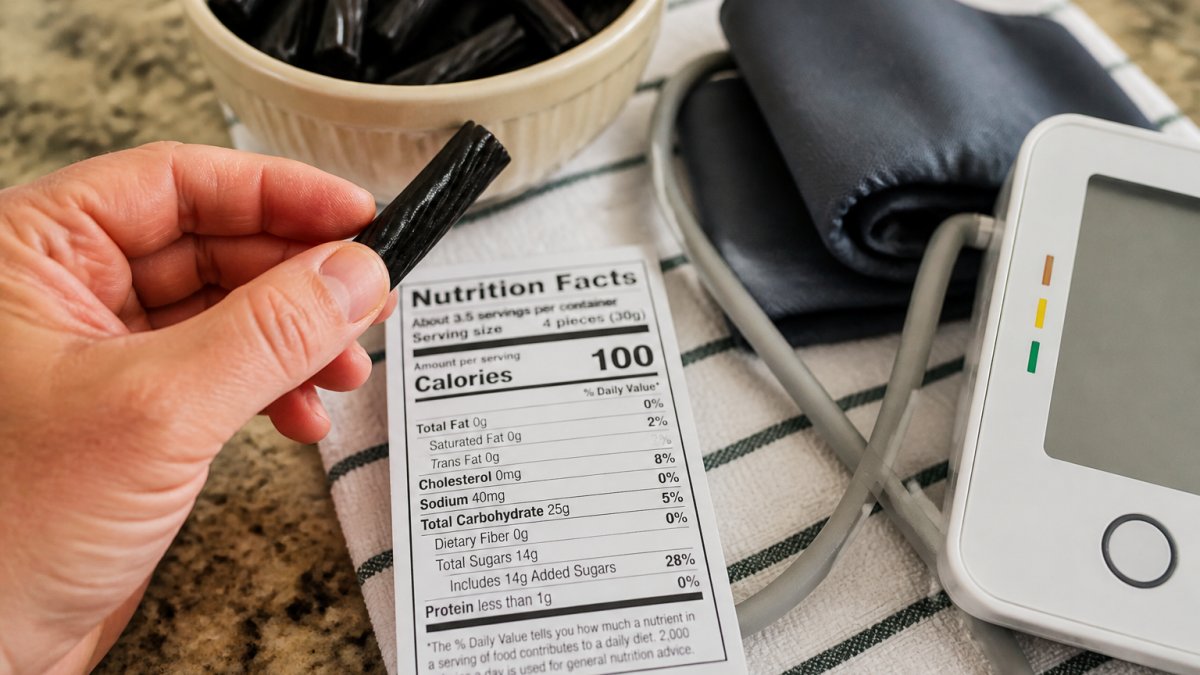
How much does it take? A study of young, healthy people found that a daily intake of 100 mg of glycyrrhizin, taken as 3.3 g of licorice for two weeks, raised blood pressure, as summarized by the British Heart Foundation's explainer on liquorice and blood pressure.
Black Licorice vs Red Licorice: Two Very Different Snacks
Red licorice usually contains no licorice root at all. Most red varieties are fruit-flavored candy, built on flour, sugar, and flavoring, which means they carry none of the glycyrrhizin risk that black licorice does.
That distinction matters more than the artisanal question. For a deeper look at how the two styles differ, read our guide to black vs fruit licorice.
Ingredient-by-Ingredient: Licorice Root, Fillers, and Flavoring
Ingredient order on a label runs from largest to smallest amount, and that is where artisanal and conventional licorice tend to converge. Sugar, corn syrup, and wheat flour usually lead in both. The differences show up further down the list.
- Licorice root or extract: the source of glycyrrhizin. Some "licorice" candy uses anise oil instead, which tastes similar but contains no glycyrrhizin.
- Sweeteners: sugar and syrups for texture and flavor. Sugar-free versions use sugar alcohols or other sweeteners.
- Fillers and binders: flour, starch, and gelatin hold the chew together.
Anise is worth flagging. WebMD reports that most licorice candies are not made with real licorice, and quotes the National Center for Complementary and Integrative Health's position that there is not enough high-quality evidence to clearly support licorice for any health condition (WebMD's report on black licorice health benefits).
How Much Licorice Is Too Much? Serving Guidance and Risk Groups
Serving guidance is where most articles stop short, so here is a practical framework built around the one compound that makes black licorice different from every other candy: glycyrrhizin. The question is not "is one piece safe" but "how much, how often, and for whom."
The Glycyrrhizin Threshold in Plain Terms
The concern with black licorice is dose and duration. Research summarized by the American Heart Association and other public health sources points to daily glycyrrhizin intake in the range of about 100 mg as a level at which blood pressure can rise in otherwise healthy adults, and that intake corresponds to a modest daily amount of traditional black licorice, on the order of a couple of ounces a day for a couple of weeks.
Because glycyrrhizin content varies by recipe, the label is your only guide. Some products list licorice extract; many do not list a glycyrrhizin amount at all. When the number is missing, treat the product as unknown rather than assume it is low.
Who Should Be Most Careful
The people at highest risk are not the casual snackers. They are:
- People with high blood pressure, because glycyrrhizin can push blood pressure higher.
- People with heart or kidney conditions, because potassium balance matters more for them.
- People taking diuretics or certain blood pressure medications, because the electrolyte effects can compound.
For these groups, the cautious move is to skip daily black licorice and ask a clinician before making it a regular habit. For everyone else, portion control covers most of the risk.
A Practical Checklist Before You Buy
- Check whether the label lists licorice root or extract, or only anise oil
- Note the serving size and sugar per serving
- Keep black licorice occasional rather than a daily habit
What 'Occasional' Looks Like
A workable rule of thumb is to treat black licorice as a treat measured in pieces per week, not pieces per day, and to avoid stacking it with other licorice-containing products such as licorice tea or supplements. If you notice swelling, unusual fatigue, or muscle weakness after a stretch of regular consumption, stop and talk to a clinician. The 2012 review's core warning is about chronic, excessive consumption, not a single piece at a movie.
Pick Your Bag: Classic Black, Classic Red, or the Flavor of the Month
Knowing the label is the whole game, and once you know it, buying is simple. Our Classic Black Dude is the traditional black option, priced at $8.00, for anyone who wants the real licorice-root flavor and plans to enjoy it in moderation. Our Red Dudes Classic Red is the old-fashioned red, also $8.00, with none of the glycyrrhizin question. And if you want to explore without committing to a full case, the Flavor of the Month 5-pack bundles five 16-ounce bags of one featured flavor for $25.00.


Frequently Asked Questions
Is licorice candy healthy for you?
Most licorice candy is a treat, not a health food. WebMD reports that most licorice candies are not made with real licorice, and the National Center for Complementary and Integrative Health says there is not enough high-quality evidence to support licorice for any health condition. A 2012 review in a PubMed Central indexed journal also warns that licorice's nutritive value is overrated and that liberal consumption can occasionally be hazardous. Treat artisanal licorice as candy with a distinctive flavor, not as a supplement.
Does artisanal licorice have less sugar than regular candy?
Not automatically. Sugar content in licorice candy depends on the recipe, not the batch size, so check the nutrition panel per serving rather than assuming small-batch means less sugar. Some artisanal makers use molasses or cane sugar, which still counts as added sugar. If sugar is your concern, compare grams per serving across the bags you are considering, including our Classic Black Dude and Red Dudes Classic Red, and watch portion size, since a 16-ounce bag holds several servings.
What are the potential side effects of consuming black licorice?
The main concern is glycyrrhizin, the compound in licorice root. The American Heart Association cautions that traditional black licorice can disrupt potassium levels and lead to potentially severe cardiac consequences. A study of young, healthy people summarized by the British Heart Foundation found that 100 mg of glycyrrhizin daily, taken as 3.3 g of licorice for two weeks, raised blood pressure. People with heart conditions, high blood pressure, or those taking diuretics should be especially careful and talk to a doctor.
Is black licorice healthier than red licorice?
They carry different risks. Traditional black licorice can contain licorice root extract and glycyrrhizin, which is where the blood pressure and potassium warnings come from. Red licorice is usually flavored with anise or artificial flavoring and contains no licorice root, so it avoids that specific concern, though it can still be high in sugar. Neither is a health food. If you eat black licorice regularly, keep servings small and check with a doctor if you have heart or blood pressure issues.
The label decides whether any licorice fits your diet, and we would rather help you read it than sell you a slogan. Hey Licorice Dude stocks a wide range of flavors, from classic black to fruit varieties, with simple online ordering and a Flavor of the Month bundle that makes trying something new easy. Get started with Hey Licorice Dude and find the bag that matches how you actually snack.
